

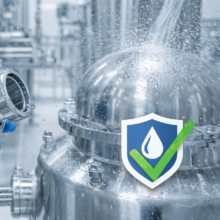
In process engineering and plant construction, Hygienic Design refers to the consistent hygienic design of machines, systems and components. The objective is to prevent contamination, enable efficient cleaning and ensure long-term product safety.
This is particularly critical in the food, beverage and pharmaceutical industries. Product residues or contamination can endanger consumers, lead to product spoilage, production downtime or costly recalls – and ultimately result in significant economic losses.
RECHNER Sensors – Designed for Hygienic Applications
RECHNER sensor solutions are specifically developed for applications with high hygienic requirements. Hygienic Design principles are already taken into account during the development and design phase. Our sensors comply with relevant national and European guidelines and are aligned with recognized Hygienic Design principles, such as those described in Food & Pharma Basics.
Our sensors support Hygienic Design through:
-
Smooth, easy-to-clean surfaces
to minimize product adhesion and residues -
Dead-space-free or low dead-space designs
for safe and reproducible cleaning processes -
Materials suitable for hygienic applications
such as stainless steel or high-performance plastics -
Reliable sealing concepts and defined transitions
-
Suitability for CIP and SIP cleaning processes (application-dependent)
Greater Safety for Your Products
Thanks to their hygienic design, RECHNER sensors actively help to:
-
Reduce the risk of contamination
-
Shorten cleaning times and minimize downtime
-
Increase process reliability and product quality
Our solutions are used wherever product protection, process stability and regulatory compliance are essential.
Proven Solutions in Practice
Example of a hygienic sensor solution:
Sensor KA1244
with accessories 196394 and 196395
Your application – our responsibility.
Talk to our experts. We will support you in selecting the right Hygienic-Design-compliant sensor solution for your process.